For decades we have watched the way we talk about machines — one of us from futures research, the other from dance. And we keep making the same mistake. We treat intelligence as a substance that can be decanted: first we have it in the mind, then in the code, eventually in the robot. In this story the body is a container. Something that merely transports the real thing — thinking.
We believe this is wrong. And with every year that artificial intelligence grows more powerful, more dangerously wrong.
Embodied intelligence is our counter-proposal. The term holds that intelligence is not poured into a body but comes into being only through embodiment. Anyone who has ever asked a dancer to portray “fear” knows what is meant: what happens there is not a calculation subsequently translated into muscle. It is a bodily memory, a knowledge that sits in the flesh and cannot be fully dissolved into rules. We call it “gut feeling”, dismissively. In truth it is one of the highest forms of intelligence we know — situated, immediate, unrepeatable.
The insight is not new. It runs from Merleau-Ponty’s lived body through enactivism to Rodney Brooks’ claim that there is “intelligence without representation”. What is new is the moment at which we say it. Because three macro trends are converging right now.
Artificial intelligence
Large models have shown that the intelligent can be described, mapped in patterns and reproduced — not only language, but increasingly judgement, aesthetics, decision. What long counted as irreducibly human is becoming modellable.
Robotics
It embodies intelligence mechanically — software inside a constructed humanoid device. Impressive, but the old separation remains: mind here, hardware there.
The human-machine fusion
This is the actual rupture. Signals from an AI model are played directly into the human body — muscles that move because a machine “knows” the movement, while the person has never practised it.
Suddenly you can play an instrument, dance a figure, speak a sign language you never learned. Not as a metaphor — physically.
This is precisely where the vision lies that has not let go of us for months: from imagination to execution. The state in which a thought becomes realisation directly, without the many hurdles in between — without the laborious detour through language, instruction, years of practice. The patches on the arm are only an aid along that path. The goal is a new mode of being: imagination that takes effect unimpeded. That is as fascinating as it is in need of responsibility — because this capability, like every other, is also open to those who would abuse it. So the euphoria must come with sobriety: rules, morality, a civilised frame. Without them it turns wild.
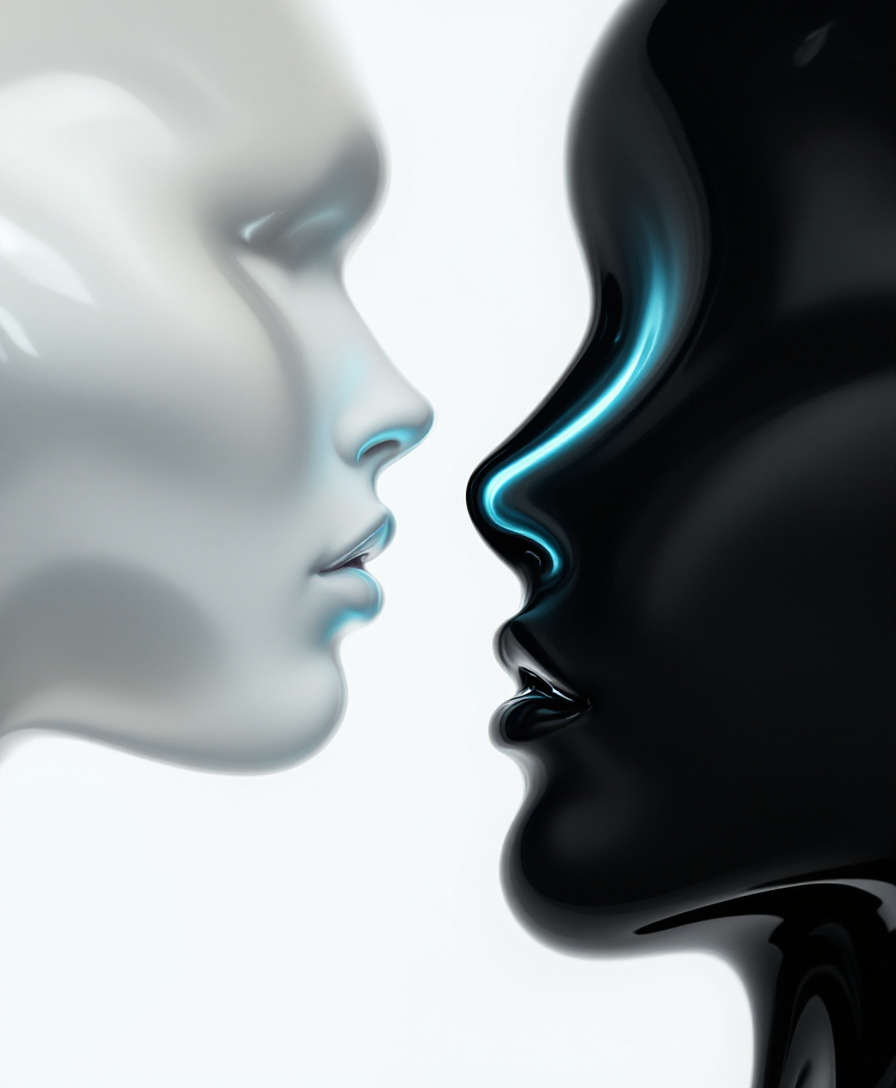
Embodied intelligence is our answer to the question of what becomes of the human being in this fusion. It shifts the dispute. The usual question runs: human or machine — which is better? The wrong question. Because intelligence does not reveal itself in the substrate it springs from, but in the expression through which it appears. Competition gives way to interplay: AI as co-author, the body as the stage on which its proposals become alive, vulnerable and open to interpretation. This is not the human capitulating. It is the rediscovery of what makes us human — in the middle of the Anthropocene, in the middle of technologisation.
Intelligence does not reveal itself in the substrate it springs from — but in the expression through which it appears.
So that this does not stay theory, we are putting it to the test. ODILE — our research project at the intersection of choreography and artificial intelligence — is where that test happens. A dance theatre in which one half of a choreography is devised by a human, the other half by a machine, and both are danced by the same body. The audience should not be able to tell them apart. A blind tasting of intelligence. If it succeeds, the thesis is proven — not in an essay but in a body: embodied intelligence is not a state but an event. New every single time.
We believe more hangs on this term than an academic question. We are deciding whether to narrate the coming fusion as a loss — or as an expansion. We have decided.